
October 05, 2026
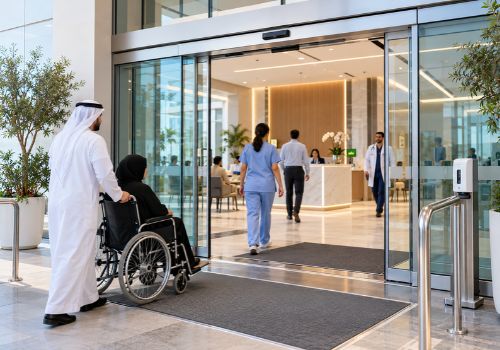
A clinic entrance is more than just a way to enter a building. It is the first point where patients, staff, visitors, wheelchairs, and medical equipment move through the facility. For a busy clinic, a door that is difficult to open or creates crowding can slow down movement and make the entrance less comfortable.
This is why Automatic Doors for Clinics in Dubai are becoming a practical choice for healthcare facilities. They allow people to enter without touching a handle, support smoother movement, and can be designed around the needs of patients and staff.
From small medical centres to large healthcare facilities, automatic doors can help improve hygiene, accessibility, safety, and patient flow when the right door system is selected.
Clinics usually have a steady flow of people throughout the day. Patients may arrive with family members, elderly people may need extra space, and staff may move between areas while carrying equipment or supplies.
A manual door can create unnecessary contact and may also become difficult to manage during busy periods.
With automatic doors for clinics, the door opens when the sensor detects a person approaching. This reduces the need to touch handles and allows people to move through the entrance more easily.
For healthcare facilities, some of the main benefits include:
The goal is not simply to make a clinic entrance look modern. The door should make everyday movement easier and safer.
Hygiene is an important concern in clinics. Patients, visitors, doctors, nurses, and other staff may use the same entrance throughout the day.
A traditional door handle is a common touch point. With touchless automatic doors, people can enter without pulling or pushing the door by hand.
This does not replace normal cleaning and infection control practices, but it can reduce unnecessary contact at the entrance.
Automatic sliding doors are especially useful because they can open and close without requiring people to touch the door. Deto’s automatic sliding door systems use sensors and motorised movement to provide hands-free entry.
For clinics, this can be useful at:
The right system depends on the size of the entrance, expected traffic, available space, and the type of healthcare facility.
Patient flow means how easily people move from one area of a clinic to another.
A poorly planned entrance can create queues near reception or cause people to stop and wait while someone opens a door. This becomes more noticeable during busy hours.
Automatic clinic doors Dubai solutions can help reduce this problem by opening automatically when someone approaches.
For example, a patient using a wheelchair does not need to stop and reach for a door handle. A staff member carrying files or equipment can move through without putting everything down.
Automatic doors can also help when several people are entering at the same time.
For busy healthcare facilities, the door should be selected according to expected traffic instead of choosing a system only because it looks attractive.
Automatic sliding doors Dubai solutions are one of the most common choices for clinic entrances because the panels move sideways instead of opening into the walking area.
This can be useful where space near the entrance is limited.
Automatic sliding door solutions by Deto can include different configurations depending on the available opening and traffic requirements. Standard sliding doors can work well for regular entrances, while telescopic systems can be useful where a wider opening is needed within a limited space.
For example, a clinic may consider:
| Door Type | Suitable Use | Main Benefit |
| Standard sliding | Clinic main entrance | Smooth everyday movement |
| Telescopic sliding | Smaller available space | Wider opening with stacked panels |
| Hermetic sliding | Labs and controlled areas | Better sealing |
| Automatic swing | Internal clinic areas | Useful where sliding is not suitable |
| Curved sliding | Premium healthcare entrances | Modern appearance |
The door type should be selected after checking the entrance dimensions, traffic level, safety requirements, and space available around the doorway.
Accessibility is another major reason clinics choose automatic entrance systems.
Patients may arrive using wheelchairs, walking aids, crutches, or other mobility support. Elderly patients may also find heavy manual doors difficult to open.
An accessible automatic door can reduce this physical effort.
The opening width is important. The entrance should provide enough clear space for a wheelchair or other mobility equipment to pass comfortably.
Sensors should also be positioned correctly so that the door detects people approaching the entrance and does not close too early.
For a clinic, accessibility should be considered during the initial design rather than treated as an extra feature after installation.
Automatic doors need to be convenient, but safety should come first.
A suitable healthcare automatic door can include safety sensors that detect people or objects in the doorway. If something is detected while the door is closing, the system can respond according to its safety setup.
Important features can include:
The exact configuration depends on the door model and installation conditions.
For clinics, safety becomes even more important because children, elderly patients, wheelchair users, and people with limited mobility may use the entrance.
A clinic cannot always stop normal movement because of a temporary power problem.
Depending on the door system, an automatic entrance may require a battery backup, UPS, generator connection, emergency release, or manual override.
The correct option depends on how the door is being used and what the building requires.
If you are planning a backup system, Deto’s guide on automatic door power failure and backup options explains how battery backup, UPS, generators, and emergency opening options can be used with automatic doors.
For healthcare facilities, backup planning should be considered before installation rather than after a power problem occurs.
Not every clinic has the same entrance layout.
Sliding doors are often useful for busy entrances because the panels move sideways and do not require swing space. Automatic swing doors can be considered where the existing entrance layout makes sliding installation difficult.
A simple comparison can help:
| Feature | Automatic Sliding Door | Automatic Swing Door |
| Space required | Side space for panels | Swing area |
| Busy entrances | Very suitable | Suitable depending on traffic |
| Wheelchair access | Good with correct opening width | Good with correct opening width |
| Hands-free entry | Yes | Yes |
| Space saving | Good | Depends on layout |
| Main entrance use | Common choice | Useful for suitable layouts |
A site inspection can help determine which system fits the clinic rather than selecting a door based only on general recommendations.
Glass is often selected for clinic entrances because it provides visibility and allows natural light into the reception area.
Automatic glass doors Dubai solutions can give a clinic a clean and professional entrance while allowing staff and visitors to see movement around the doorway.
However, glass selection should also consider safety and the intended use of the door.
Depending on the application, clinics may consider different glass and frame options. The door should be designed according to the entrance size, expected traffic, safety requirements, and overall building design.
A clinic door should not open too slowly, but it should also not operate at a speed that creates safety concerns.
Sensors need to detect people properly, while the control system should allow suitable opening and closing behaviour.
For example, a patient walking slowly with a walking aid should have enough time to pass through the entrance.
Similarly, a wheelchair user should not feel rushed while moving through the doorway.
This is why sensor placement, opening width, door speed, and closing settings should be checked during installation and testing.
Even a good automatic door needs regular maintenance.
Clinic entrances may experience high daily traffic, which can put more use on motors, sensors, tracks, and other components.
Basic maintenance can include:
Regular maintenance can help identify small problems before they affect daily clinic operations.
Healthcare facilities outside Dubai can also use automatic entrance solutions based on their local requirements.
For example, clinics looking for automatic doors in Abu Dhabi can consider solutions suited to healthcare entrances, offices, and other commercial spaces.
If the requirement is specifically for a sliding entrance, Deto also provides sliding doors in Abu Dhabi for properties that need smooth sideways movement.
Similarly, healthcare facilities in Sharjah can look at automatic doors in Sharjah when planning automated entrances.
For clinics that specifically need sliding systems in the emirate, sliding doors in Sharjah can also be considered based on the entrance layout.
Deto also serves other UAE locations, including Ras Al Khaimah, where automatic doors in Ras Al Khaimah can be considered for healthcare and commercial properties.
The right door system will still depend on the individual site, entrance dimensions, traffic, and required features.
Before choosing an automatic entrance door, clinic owners and facility managers should consider a few practical points.
Measure the available opening and surrounding space. This helps determine whether a sliding, telescopic, or swing system is more suitable.
A small private clinic may have very different traffic from a large diagnostic centre. Door components should match expected usage.
Make sure the opening width, sensor operation, and door movement are suitable for wheelchair users, elderly patients, and people using walking aids.
Ask about safety sensors, obstacle detection, emergency operation, and other relevant safety features.
For healthcare environments, touchless operation can reduce unnecessary contact with door handles.
If continuous access is important, discuss battery backup, UPS, emergency opening, or other suitable options before installation.
Ask about maintenance requirements and service support so the door remains reliable after installation.
The biggest benefit of automatic doors in healthcare is not simply their modern appearance. They make everyday movement easier.
A patient can enter without touching a handle. A wheelchair user can approach without struggling with a heavy door. Staff can move equipment more easily. Visitors can enter without creating unnecessary congestion.
When correctly selected and installed, automatic doors for healthcare facilities can support hygiene, accessibility, safety, and patient flow at the same time.
For clinics in Dubai, the best solution will depend on the entrance design, traffic, available space, and healthcare requirements. Deto Automatic Doors LLC provides automatic door solutions and installation support for healthcare and commercial properties across the UAE.
Yes. Automatic doors can be suitable for clinics because they support hands-free entry, easier accessibility, and smoother movement for patients and staff.
Yes. Automatic sliding doors are commonly suitable for busy clinic entrances because they provide hands-free entry and do not require a door leaf to swing into the walking area.
They can reduce the need to touch door handles. However, automatic doors do not replace regular cleaning and other healthcare hygiene practices.
Yes. With the correct opening width, sensor setup, and installation, automatic doors can make entry easier for wheelchair users and people with limited mobility.
There is no single option for every clinic. A standard sliding door may work well for many entrances, while a telescopic or swing system may be better depending on the available space.
They can continue to provide certain functions when suitable backup systems are installed. Battery backup, UPS, emergency release, and manual override options can be considered depending on the system.
Automatic doors can use motion sensors, presence sensors, and safety sensors. The exact sensor combination depends on the door and its application.
Yes. Sensors, tracks, motors, safety functions, and other components should be checked regularly, especially in busy healthcare facilities.
In many cases, an existing door can be automated after checking its structure, size, weight, available power, and overall condition. A site assessment is recommended before choosing the automation system.
Consider entrance size, patient traffic, accessibility, hygiene, safety, door type, sensor requirements, backup power, and maintenance support. A professional site assessment can help identify the most suitable system.
A clinic entrance should allow patients and staff to move through the building without unnecessary effort or delays. The right automatic door can support touch-free access, accessibility, patient flow, and everyday safety.
Before installation, review the entrance space, traffic level, door type, sensor setup, safety requirements, and maintenance needs. A properly planned system can provide a more practical entrance for both patients and healthcare staff.
Deto Automatic Doors LLC can assess the site and help clinics select an automatic door system based on their entrance requirements and daily use.