
June 18, 2026
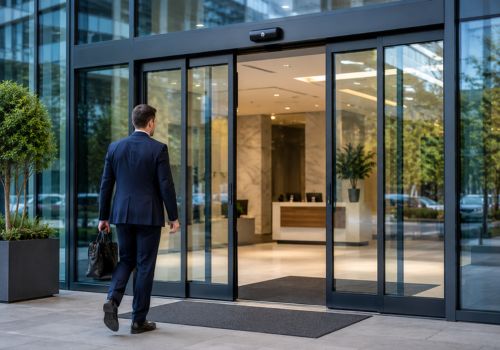
In today’s competitive business world, first impressions matter more than ever. Before a customer speaks to an employee or enters a store, they interact with the building’s entrance. A modern, smooth, and welcoming entrance can immediately create a positive experience. This is one reason why more businesses are investing in Automatic Doors for Commercial Use.
From shopping malls and hospitals to hotels and office buildings, automation is becoming a standard feature in commercial properties. Customers expect convenience, accessibility, and touch-free experiences. Business owners want solutions that improve efficiency, reduce energy costs, and create a professional image. Commercial automatic doors help achieve all these goals while enhancing safety and customer satisfaction.
As technology continues to transform commercial spaces, automatic entrance doors are no longer considered a luxury. They are increasingly viewed as a smart investment that improves both customer experience and business operations.
This guide explores whether Automatic Doors for Commercial Use are truly worth the investment, how they work, their benefits, costs, and how businesses can choose the right solution.
Automatic Doors for Commercial Use are entrance systems that open and close automatically when they detect movement, approach, or an authorized access signal. Unlike traditional doors that require manual operation, these systems use sensors, motors, and control units to provide seamless entry and exit.
They are commonly installed in:
Modern commercial door systems are available in various styles, including sliding, swinging, telescopic, revolving, and folding designs.
The operation of commercial automatic doors is surprisingly simple despite the advanced technology involved.
The system generally consists of:
When a person approaches, the sensor detects movement and sends a signal to the control unit. The control unit activates the motor, causing the door to open automatically. After the person passes through, the door closes after a preset time.
These detect movement near the entrance and trigger the door to open.
Infrared technology identifies heat signatures and movement patterns.
Pressure-sensitive mats activate the door when someone steps on them.
Used in secure facilities where entry requires cards, codes, or biometric authentication.
The result is a smooth, reliable, and convenient entrance experience.
The demand for Automatic Doors for Commercial Use continues to grow because they solve multiple business challenges at once.
They improve customer convenience, support accessibility requirements, reduce physical contact, and create a modern appearance.
Many commercial property owners also see automatic doors as a long-term investment rather than a simple building feature.
Customer experience begins at the entrance.
Imagine carrying shopping bags, pushing a stroller, moving hospital equipment, or pulling luggage through a hotel entrance. Automatic doors eliminate the need to stop and manually open a heavy door.
This convenience creates a positive impression and makes visitors feel welcome.
Benefits include:
Businesses that prioritize customer convenience often gain a competitive advantage.
Accessibility is a major consideration for modern commercial buildings.
People using wheelchairs, walkers, mobility scooters, or other assistive devices often struggle with traditional doors. Automatic entrance doors make facilities more accessible and inclusive.
Many building regulations and accessibility standards encourage or require entrances that can be easily used by everyone.
For many businesses, accessibility is both a legal responsibility and a customer service priority.
Since recent global health concerns, touch-free solutions have become increasingly popular.
Touchless entry doors reduce the number of surfaces people must touch when entering a building.
This is especially important in:
By minimizing contact points, businesses can support better hygiene practices while giving customers greater peace of mind.
One of the biggest advantages of energy-efficient automatic doors is their ability to reduce heating and cooling losses.
Traditional doors are often left open accidentally, allowing conditioned air to escape. Automatic systems open only when needed and close promptly afterward.
For high-traffic facilities, these energy savings can become significant over time.
Busy commercial locations need entrances that can handle constant movement.
Traditional doors often create bottlenecks during peak hours. Automatic sliding doors provide a continuous flow of people entering and exiting the building.
This is particularly beneficial for:
The smoother traffic flow improves customer satisfaction and operational efficiency.
Many people assume automatic doors are less secure than traditional entrances, but modern systems often include advanced security features.
Doors can work with key cards, biometric systems, and access codes.
Automatic locking mechanisms help secure the property after business hours.
Many systems include emergency override functions.
Door activity can be tracked and monitored through building management systems.
When properly configured, commercial door systems can improve security while maintaining convenience.
Businesses are constantly searching for ways to improve efficiency.
Automatic doors contribute by reducing congestion, supporting smooth traffic flow, and minimizing the need for staff assistance.
For example:
A hospital employee transporting equipment can move freely without stopping to open doors.
A hotel guest carrying luggage can enter effortlessly.
A shopper pushing a cart can move through the entrance without interruption.
Small improvements like these create significant operational benefits throughout the day.
| Feature | Automatic Doors | Traditional Doors |
|---|---|---|
| Convenience | Excellent | Moderate |
| Accessibility | High | Limited |
| Hygiene | Touch-free | Requires contact |
| Traffic Handling | Excellent | Moderate |
| Energy Efficiency | High | Lower |
| Professional Appearance | Modern | Standard |
| User Experience | Superior | Average |
| Long-Term Value | High | Moderate |
| Maintenance | Regular servicing required | Lower maintenance |
| Overall Business Impact | Strong positive impact | Limited impact |
For most high-traffic environments, Automatic Doors for Commercial Use provide greater overall value.
Not every building has the same requirements, but certain industries gain exceptional value from automatic entrances.
Retail stores benefit from increased customer convenience and smoother customer flow.
Healthcare environments require accessibility, hygiene, and efficient movement of patients and equipment.
Hotels create a stronger first impression with elegant automatic glass doors that welcome guests.
High passenger volumes make automatic entrances essential.
Modern office entrances improve professionalism and employee convenience.
Restaurants benefit from touchless access and improved customer experience.
Large visitor numbers require efficient commercial building entrances that handle constant traffic.
Cost is often the first concern for business owners considering automatic door installation.
Pricing varies based on factors such as:
While automatic doors typically cost more upfront than traditional doors, many businesses recover the investment through improved efficiency, customer satisfaction, and energy savings.
Like any mechanical system, automatic doors require routine maintenance.
Regular servicing helps ensure:
Proper maintenance significantly extends system life and performance.
Business owners often ask whether automatic doors are worth the cost.
The answer depends on traffic levels and operational needs, but many businesses experience positive returns through:
For high-traffic commercial facilities, the ROI can be substantial over the life of the system.
Selecting the right door requires careful planning.
High-traffic facilities often benefit from automatic sliding doors because they allow continuous movement.
Hospitals, hotels, offices, and retail stores all have different entrance requirements.
Choose systems that support accessibility goals and compliance requirements.
Secure facilities may require access control integration.
Look for energy-efficient automatic doors that help reduce utility costs.
Professional installation plays a major role in long-term performance.
Choosing the wrong entrance solution can create problems later.
A door designed for light traffic may struggle in busy locations.
The cheapest option is not always the most cost-effective long-term.
Maintenance planning should be part of the purchasing decision.
Businesses should consider future visitor volumes.
Poor installation can reduce performance and increase repair costs.
Avoiding these mistakes helps ensure a successful investment.
Yes. They improve accessibility, customer convenience, energy efficiency, and operational performance, making them valuable for many businesses.
With proper maintenance, most systems can operate reliably for 10–20 years or longer.
Yes. Modern systems include safety sensors, obstacle detection, emergency controls, and automatic stopping mechanisms.
Yes. They minimize air leakage and help maintain indoor temperatures more effectively than traditional doors.
Absolutely. They provide easier access for individuals with mobility challenges and support accessibility standards.
Automatic sliding doors are among the most widely used because they are efficient, reliable, and ideal for high-traffic areas.
Most manufacturers recommend professional inspections and maintenance several times per year, depending on usage.
Yes. Many systems can connect with access control, surveillance, and building management systems.
Modern automatic glass doors use strong safety glass and commercial-grade components designed for frequent use.
Most installations can be completed within a few days, although larger projects may require additional time.
Choosing Automatic Doors for Commercial Use is about more than convenience. It is an investment in customer experience, accessibility, energy efficiency, operational performance, and the overall image of your business. Whether you operate a retail store, hospital, hotel, office building, airport, restaurant, or shopping center, the right entrance solution can make a noticeable difference every day.
For businesses seeking expert guidance, Deto Automatic Doors LLC helps commercial property owners identify the most suitable entrance systems based on their specific needs, traffic levels, security requirements, and budget. From planning and automatic door installation to ongoing support, the company works closely with businesses to create reliable and modern business entrance solutions.
If you’re ready to upgrade your commercial entrance and improve the experience for customers, employees, and visitors, Contact us today to explore the right automatic door solution for your property.