
September 01, 2026
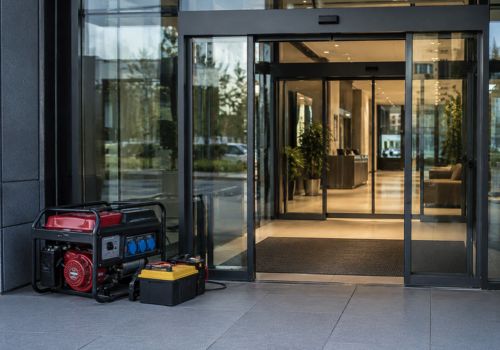
A sudden power cut can create a bigger problem than a dark office or a stopped lift. If your main entrance uses an automatic door, a power failure can affect how employees, customers, patients, guests, and delivery teams enter or leave the building.
This is why commercial properties should think about automatic door power failure before it happens. An automatic door needs electricity to run its motor, sensors, and control system. When that power is lost, the door may stop opening automatically unless it has a suitable backup or emergency opening system.
The right solution depends on the door type, traffic level, access control system, emergency requirements, and the way the building is powered. An office with a small entrance may need a different setup from a hospital, hotel, shopping mall, or warehouse.
This guide explains what happens during a power outage and how businesses can plan a safe and practical automatic door backup system.
When the main electrical supply fails, the automatic door operator normally stops receiving power. The exact response depends on the door operator and the backup equipment installed.
Depending on the system, the door may:
This means there is no single answer for what happens to all automatic doors during power outage situations.
For example, an office entrance with a battery backup may continue opening for a limited period. A hospital entrance may have a more carefully planned emergency arrangement. A warehouse may depend on a generator and manual release system.
The backup design should therefore be planned around the actual building and door.
Yes, but not normally through its standard automatic operation.
The motor and electronic controls need electrical power to operate automatically. However, an automatic door can be designed with backup power or an emergency release system that allows it to remain usable when the main supply fails.
Common options include:
Some systems combine two or more of these options.
For a commercial building, the important question is not simply whether the door can work without electricity. The better question is:
What should this door do when normal power is unavailable?
That answer should be decided during installation and reviewed during maintenance.
There are several ways to provide automatic door backup power. Each option has a different purpose.
| Backup option | Where it is useful | Main benefit | Important limitation |
| Battery backup | Offices, shops, hotels, entrances | Keeps the door operator running for a limited period | Capacity depends on the system and usage |
| UPS | Doors connected to sensitive electronic systems | Provides temporary backup and helps protect equipment | Requires correct sizing and maintenance |
| Generator | Large commercial buildings | Can support several building systems | Door must be correctly connected to the backup supply |
| Emergency opening/manual override | Emergency exits and essential entrances | Allows access when automatic operation is unavailable | Requires a suitable door design and clear procedure |
| Combined backup | Hospitals, malls, busy commercial buildings | Provides more than one layer of protection | More planning, equipment, and maintenance are required |
The best commercial automatic door backup is the one that matches the building’s actual needs rather than simply choosing the largest battery or most expensive system.
A battery is one of the most common solutions for short-term backup.
An automatic door battery backup stores electrical energy while the main power is available. When a power failure occurs, the battery can supply the door operator so the system can continue performing its designed function for a limited period.
This can be useful for:
A battery system can be especially useful when a building experiences short power interruptions.
There is no universal backup time for every automatic door.
Battery performance can depend on:
A busy shopping entrance that opens repeatedly may use backup energy much faster than a small office entrance.
This is why businesses should not select a battery based only on a claimed number of hours or cycles. The installer should check the actual door and expected usage.
A UPS, or Uninterruptible Power Supply, is another backup option.
An automatic door UPS supplies temporary power when the main electrical supply fails. It can be useful when the door is part of a wider electronic setup or when a stable power supply is important.
A UPS can potentially support:
However, not every UPS is suitable for every automatic door. The power requirement, connection method, load, battery capacity, and operating conditions need to be checked before installation.
A qualified professional should confirm whether a UPS is suitable for the specific door operator.
Battery backup and UPS systems can sound similar, but the final choice depends on the equipment and building setup.
A dedicated automatic door battery backup may be a practical choice when the main goal is keeping the door operator functional during a short power interruption.
A UPS may be more suitable when the automatic door needs temporary power alongside other sensitive electronic equipment.
Neither option should be selected only because it sounds more powerful.
The important questions are:
Yes, a generator can support an automatic door if the door’s electrical supply is correctly connected to the building’s backup power system.
This can be useful in large commercial properties where a generator already supports essential electrical systems.
For example, a shopping mall may have a generator supporting selected building services during a power outage. An automatic entrance can potentially be connected to an appropriate backed-up circuit.
However, a generator does not automatically solve every automatic sliding door power failure problem.
The system still needs to consider:
If the generator takes time to start, the door may still need a battery or emergency opening arrangement during that gap.
Backup power is useful, but manual operation still matters.
A properly designed automatic door emergency opening method provides another way to use the entrance if automatic operation becomes unavailable.
The exact method depends on the door system. It may involve a manual release, emergency opening mechanism, breakout arrangement, or another approved configuration.
This is especially important for:
Businesses should make sure staff understand how the door is supposed to operate during a power failure.
A manual override should not be treated as something that only matters after the door stops working. It should be checked during routine testing.
For emergency exit planning, businesses can also read Deto’s guide on Emergency Exit Doors and safety requirements in Dubai.
These terms can sound complicated, but the basic idea is simple.
A fail safe setup is generally designed to release or allow safe passage when power is lost, depending on the equipment and application.
A fail secure setup is generally designed to keep a secured area locked when power is lost.
The correct choice depends on what the door is protecting and what people need to do during an emergency.
For example, an access controlled office door may have different requirements from an emergency exit. A hospital entrance may need another arrangement because patients, visitors, and staff must be able to move safely.
The automatic door, locking system, access control, fire alarm interface, and emergency requirements should therefore be considered together.
Do not choose fail safe or fail secure simply based on the name. Have the complete setup reviewed by a qualified door and access control professional.
Automatic doors are often connected to:
A power failure can affect these systems too.
For example, a door operator may have battery power while the card reader does not. In that situation, the door may have backup power, but the access control system may still prevent normal entry.
A proper automatic door power outage solution should therefore consider the complete entrance rather than only the motor.
The installer should check:
This is especially important for offices, hospitals, hotels, warehouses, and other controlled commercial environments.
Safety sensors help detect people or obstacles around an automatic door.
During normal operation, they can help prevent the door from closing when someone is in the doorway.
A backup system should not remove the importance of these safety functions.
If a door continues operating through battery or UPS power, its safety devices should also be considered as part of the backup arrangement.
For commercial buildings, safety should come before simply keeping the door moving.
Deto’s automatic sliding door systems use sensors and can be configured for commercial, healthcare, and hospitality applications. Businesses considering a new system can review the Automatic Sliding Doors page for more information about available configurations.
There is no single automatic door backup that suits every commercial property.
A small office may have moderate traffic and a simple entrance.
A suitable setup may include:
A hospital entrance may need a much more carefully planned arrangement because people may include patients, wheelchair users, staff, and visitors.
The backup plan may involve:
The exact arrangement should be confirmed for the specific entrance.
Hotels need entrances that remain practical for guests carrying luggage.
A backup system may need to support:
Malls can have very high traffic during busy periods.
The system may require:
A warehouse may use automatic doors for employee access, loading areas, or controlled entrances.
The backup plan may be different because door size, traffic, security, and emergency exit requirements can all vary.
Before selecting a backup system, answer these questions.
Is it:
Different operators have different power requirements.
If you are considering telescopic systems, Deto’s guide to Telescopic Automatic Doors explains how these systems are used in hospitals, hotels, offices, malls, and other commercial environments.
Count the approximate level of traffic.
A door used hundreds of times during busy periods may require a different backup capacity from a small office entrance.
Decide what the door needs to do when normal power disappears.
Should it:
The answer should come from the building’s safety and security requirements.
If the door uses card access, biometric access, or another security system, include that equipment in the backup plan.
If the property already has generator support, check whether the automatic door is connected to the correct backup circuit.
The operator manufacturer can specify compatible batteries, UPS equipment, electrical requirements, and operating limits.
Backup equipment is only useful when it is working.
Choose a setup that can be inspected, tested, repaired, and maintained properly.
Testing should not wait until the next power cut.
A planned test can help identify problems before they affect building operations.
A professional check may include:
The testing frequency should follow the manufacturer’s instructions, building maintenance plan, equipment condition, and applicable requirements.
Do not intentionally disconnect important building systems without following a safe testing procedure.
A battery or UPS may not be suitable simply because its capacity looks large.
Rechargeable batteries lose performance over time. A backup system should be inspected rather than assumed to be ready.
Keeping the motor powered does not necessarily mean every connected security device will work.
Staff may not know how to manually release or operate the door during a power failure.
A main hotel entrance, emergency exit, warehouse door, and office entrance can have very different requirements.
Incorrect wiring, poor sizing, or unsuitable equipment can create operational and safety problems.
A good backup plan should answer three simple questions:
What happens when normal power fails?
Know exactly how the door is expected to behave.
How long does the building need the door to remain operational?
This depends on the building, traffic, emergency plan, and backup power arrangement.
What happens when backup power is exhausted?
There should still be a suitable manual or emergency method where required.
This approach is more useful than simply asking for the biggest battery available.
Yes, if it has a suitable battery, UPS, generator connection, or another approved backup arrangement. Without backup power, automatic operation may stop, although a manual or emergency opening method may still be available.
Some automatic sliding doors can be equipped with battery backup, but it is not safe to assume every door has one. The operator and installation should be checked to confirm the available backup configuration.
The door may stop automatic operation, move to a designed emergency position, continue operating through backup power, or allow manual opening. The exact response depends on the door system.
Not always. A dedicated battery system may be enough for some doors. A UPS may be useful when temporary power is needed for the door and related electronic equipment.
There is no fixed time for every door. Battery size, door weight, operator type, traffic level, opening frequency, and connected equipment all affect the available backup period.
Yes. An automatic door can potentially be connected to a building generator if the electrical system and door operator are designed and installed correctly.
Depending on the door design, it may have a manual override, emergency release, breakout function, or another manual opening method. The correct method should be confirmed for the specific door.
There is no single best option. Battery backup, UPS, generator support, and manual emergency opening each have different uses. The correct choice depends on the door, traffic, access control, emergency requirements, and building setup.
They should be checked as part of the door’s planned maintenance and according to the manufacturer’s recommendations. Testing should also consider battery age, condition, and actual backup performance.
They may be important where continued operation, controlled access, emergency movement, or business continuity matters. The required backup arrangement should be decided based on the building’s specific needs rather than applying one solution to every door.
An automatic door power failure is easier to manage when the building has a clear backup plan. Battery backup, UPS support, generator power, emergency opening, and manual override can all play different roles.
The right choice depends on your door type, daily traffic, access control, emergency requirements, and building power setup. A hospital may need a different arrangement from a retail shop, while a mall or large office building may need several layers of backup.
If you are installing a new automatic entrance, upgrading an existing system, or dealing with repeated power-related door problems, Deto Automatic Doors LLC can help assess the door, operating requirements, installation needs, maintenance requirements, and suitable backup options for your commercial property in Dubai and the UAE.