
September 03, 2026
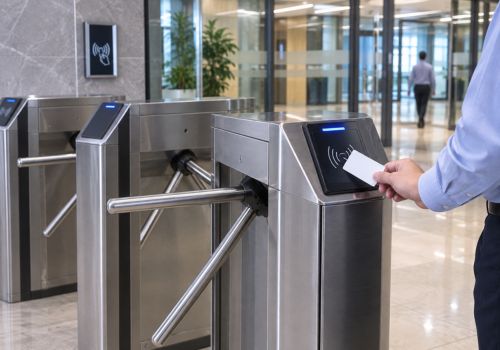
A turnstile gate becomes much more useful when it is connected to an access control system. Instead of allowing everyone to walk through, the system can check whether a person has permission to enter before the gate allows passage.
This is where turnstile gate access control works with RFID cards and card readers. An employee carries an RFID card, taps or presents it near the reader, and the reader sends the card information to the access control system. The system checks the person’s permission and then tells the turnstile whether to allow or reject entry.
This setup is useful for offices, business parks, factories, schools, gyms, hospitals, residential communities, malls and other properties where controlled pedestrian entry is required.
The important part is that the card, reader, controller and turnstile each have a different job. Once they are connected correctly, they work as one entry system.
Turnstile gate access control is a system that connects a pedestrian turnstile with access control equipment to decide who can pass through a controlled entrance.
A simple setup normally includes:
The RFID card identifies the user. The reader reads the card. The controller checks whether that card is allowed to enter. The turnstile then responds to the decision.
The system can also store entry information, depending on the access control software and configuration being used.
For a business, this means employees do not simply walk through an open entrance. Their access can be controlled according to the permissions set by the building administrator.
These three components are often confused, but their jobs are different.
| Component | What it does | Simple example |
| RFID card | Identifies the user | Employee access card |
| RFID reader | Reads the card information | Device beside the turnstile |
| Access controller | Checks whether access is allowed | System that makes the access decision |
| Turnstile gate | Allows or blocks physical entry | Gate that rotates or opens |
RFID means Radio Frequency Identification. In simple terms, an RFID card can communicate its stored identification information to a compatible reader without needing to be inserted into the device.
The RFID card reader turnstile setup usually places the reader close to the point where the user approaches the gate.
The access controller is the part that applies the access rules. For example, an employee may be allowed to enter from 8 AM to 7 PM, while a contractor may have access only to a particular area or time period.
The complete process is easier to understand when broken into steps.
An employee approaches the entrance and holds the RFID card near the reader.
The card does not need to physically touch the reader in many RFID setups. The exact reading distance depends on the card and reader being used.
The reader receives the card’s identification information.
At this point, the reader is not deciding whether the employee should enter. Its main job is to read the credential and pass the information to the access control system.
The turnstile gate access control system checks the card against the permissions configured by the administrator.
The system may check things such as:
If the credential is valid and the user has permission, the system sends an authorization signal to the turnstile.
If the credential is not permitted, the gate remains locked or does not allow the person to pass, depending on the system design.
After authorization, the access control turnstile allows the person to pass.
The exact movement depends on the gate type. A tripod model may release its rotating arms, while a flap barrier may open its wings.
Depending on the access control software, the system can record information about the access event.
This can help an administrator review employee entry activity or investigate an access event when needed.
This entire process can happen quickly, so employees can use a controlled entrance without needing a security guard to manually check every card.
Imagine an employee arrives at a corporate office at 9:00 AM.
The employee holds an RFID card near the turnstile gate with card reader.
The reader detects the card and sends its identification information to the controller. The controller checks the employee’s access permission and confirms that the card is active and allowed at that entrance.
The controller sends the authorization signal to the turnstile.
The turnstile releases, allowing the employee to pass.
The access software can then record the entry event.
Now consider a different employee whose card has been disabled. When that person presents the card, the reader can still detect it, but the access system can reject the request because the credential is not currently permitted.
The gate does not open.
This is the basic relationship between the RFID card, reader, controller and gate.
Different turnstile designs can be connected to access control equipment. The right option depends on the property, available space, traffic level, appearance and security requirements.
A tripod turnstile uses three rotating arms. It can be suitable for places such as gyms, schools, smaller offices and controlled employee entrances.
It can work with an RFID reader so that the arms release after valid authorization.
Flap barriers use moving panels that open after successful authorization.
They can suit office lobbies, corporate buildings and other locations where appearance and organized pedestrian movement are important.
Swing gates can provide a wider opening than some traditional turnstiles. This can make them useful where accessibility or wider pedestrian movement needs to be considered.
They can also be integrated with card readers and access control equipment.
A full height turnstile creates a more enclosed controlled passage. It can be considered for locations where stronger physical control of pedestrian entry is required.
The correct choice should be based on the site’s actual requirements rather than simply selecting the model with the highest level of physical restriction.
Deto’s existing guide on turnstile types can also help when comparing different gate designs before making a purchase. Read the guide to turnstile gate types
One useful feature of an RFID access control system is that different people can receive different permissions.
For example:
| User | Possible access |
| Employee | Main office entrance during working hours |
| Manager | Office plus restricted areas |
| Visitor | Specific entrance for a limited period |
| Contractor | Selected areas during approved working hours |
| Security staff | Multiple controlled entrances |
The exact permissions depend on the access control software and how the administrator configures the system.
This gives businesses more control than simply giving every person the same physical key or allowing unrestricted entry.
A lost card should normally be reported to the building administrator or security team as soon as possible.
In a compatible access control system, the administrator can normally disable or remove the lost credential and issue a replacement card.
This means the physical card does not have to remain permanently active just because it was originally issued.
The exact process depends on the access control software and system configuration.
RFID is only one way to control a turnstile.
| Access method | How it works | Practical consideration |
| RFID card | User presents a registered card | Simple for regular employees |
| PIN | User enters a code | No physical card required |
| QR code | User presents a digital code | Useful for selected visitor or temporary access setups |
| Biometrics | System checks a physical characteristic | Useful where biometric access is suitable |
| Mobile credential | Phone is used as the credential | Convenient for users who support the required technology |
RFID cards can be convenient for businesses because employees can carry one physical credential and use it at compatible entry points.
However, RFID is not automatically the best choice for every building. The decision should consider the users, security requirements, existing access control system, budget, visitor process and future expansion plans.
Before purchasing a RFID turnstile gate, check how the gate and access control equipment will work together.
Make sure the selected reader can communicate with the access control system you plan to use.
The controller must support the required readers, credentials and access rules.
Ask whether the system can record access events and what information administrators can review.
If your building receives visitors, check whether temporary access can be created and removed easily.
Ask how the gate behaves during an emergency and whether it has the required emergency release arrangements for the site.
Do not assume every gate behaves the same way when power is lost. Ask whether backup power is available and what the configured operating mode will be.
Some systems can include sensors or other controls designed to detect situations where more than one person attempts to pass after a single authorization. Availability depends on the gate and system.
Decide whether the entrance needs one-way access, two-way access or separate entry and exit lanes.
The selected equipment should match the installation environment and expected use.
If your company may add more entrances later, choose a system that can support the planned expansion.
A successful turnstile gate installation requires more than placing the gate on the floor.
The installation team should review:
The site should be assessed before equipment is selected. A gate that works well in one office may not be the right fit for a crowded factory, school or residential entrance.
For commercial properties, professional installation can also help ensure the physical gate, reader and control equipment are properly coordinated.
There is no single answer because different systems are configured differently.
During a power failure, the turnstile may stop operating, move to a configured emergency position, or continue operating for some time if a suitable backup power system is installed.
A network interruption can also affect systems differently. Some controllers may continue making decisions locally, while other configurations may depend more heavily on communication with central software.
For this reason, buyers should ask the installer:
The answer depends on the turnstile, controller, software, power backup and site configuration.
The best system is not simply the one with the most features. It should match how your property actually operates.
For an office, appearance, employee access and visitor management may be important.
For a factory, durability, controlled employee movement and reliable operation may receive more attention.
For a gym, fast member entry may matter more.
For a residential community, the system may need to manage residents, staff, visitors and temporary users.
For a school or educational institution, controlled entry and different user permissions may be important.
For high traffic sites, the gate should also be selected according to expected pedestrian volume so that the entrance does not become a bottleneck.
A turnstile access control system is made up of several connected parts. A problem with compatibility, wiring, reader placement or configuration can affect the complete entry process.
A professional installer can assess the entrance, recommend suitable equipment and coordinate the gate with the access control setup.
Deto Automatic Doors LLC provides turnstile solutions as part of its wider range of automated entrance and access systems. Its site also lists professional installation, maintenance and support services for automated systems. View Deto’s installation and automation services
For sites that already have an access system, it is especially important to discuss compatibility before buying a new gate.
A turnstile gate access control system works by connecting four key stages: the RFID card identifies the user, the card reader reads the credential, the access controller checks permission, and the turnstile allows or rejects physical entry.
When planned correctly, this setup can help businesses manage employee entry, control restricted areas and maintain useful access records. The right configuration depends on the type of property, number of users, traffic level, existing systems, emergency requirements and available installation space.
If you are planning a new entrance or upgrading an existing access control setup, Deto Automatic Doors LLC can help assess the site requirements and discuss suitable turnstile and access control options.
An RFID card is presented to a compatible reader. The access control system checks the card’s permission and, if approved, sends a signal that allows the turnstile to open or rotate.
Yes. Many turnstile systems can be integrated with compatible RFID readers so that users can gain entry after their credentials are approved.
The reader detects the card and sends its identification information to the access control system. If the card has permission, the system authorizes the turnstile to allow passage.
The reader reads the card. The access controller checks the card’s permission and makes the access decision.
Usually, yes. An administrator can normally disable or remove the lost credential from a compatible access control system and issue a replacement.
It depends on the equipment, backup power and configuration. Buyers should confirm the gate’s power failure and emergency operating behavior before installation.
Yes. RFID turnstiles can be suitable for offices where controlled employee entry, visitor management and access records are required.
There is no single best method for every property. RFID, PIN, QR, biometrics and mobile credentials can each suit different users and requirements.
Yes, when the gate is connected to compatible access control software that supports access event logging.
The cost depends on the turnstile type, reader, controller, software, number of lanes, installation conditions, access features and other project requirements. A site assessment is the best way to determine the required setup and quotation.