
October 01, 2026
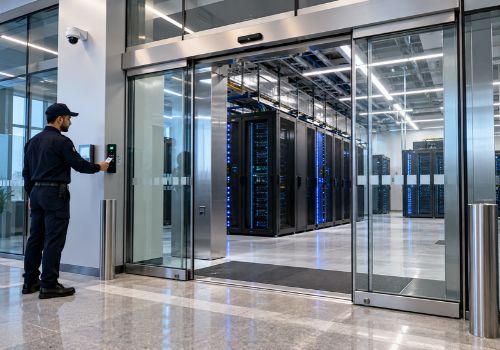
A data center is not like a regular office. It houses servers, network equipment, storage systems, and other technology that businesses depend on every day. Access must be controlled, equipment must stay protected, and essential operations must continue with as little disruption as possible.
That is why automatic doors for data centers in Dubai need careful planning. The right door system can help manage entry, support movement between secure areas, and work with access control equipment. However, an automatic door alone cannot provide complete security or guarantee uninterrupted operations. Its design must match the building’s security rules, emergency plan, electrical supply, and daily needs.
For data center owners, facility managers, security teams, and MEP contractors, the goal is to select a door system that supports safe movement without weakening access control.
Data centers often have different access levels. The main entrance may be open to approved visitors, while server rooms and other sensitive areas need much stricter controls.
Well-planned automatic doors for data centers can support these different needs in several ways.
These benefits depend on the door type, hardware, installation, and control settings. A door selected for a general office may not meet the needs of a secure technical area.
Data center door access control helps decide who can enter a specific area and when entry is allowed. The automatic door provides the physical opening, while the access control system checks permission.
For example, an employee may present an access card at a reader. The system checks the employee’s permission. If access is approved, the controller sends a signal to the door operator or locking device. The door then opens according to its settings.
If permission is denied, the door should remain secured as designed.
The complete setup may include several components.
| Component | What It Does | Why It Matters |
| Access card or credential | Identifies the person requesting entry | Helps restrict entry to approved users |
| Card reader or biometric reader | Reads the user’s credential | Provides a controlled way to request access |
| Access control panel | Checks access rules and sends commands | Applies the site’s entry permissions |
| Door operator | Moves the automatic door | Opens and closes the entrance |
| Electric lock, where required | Secures the door | Adds physical control to the entrance |
| Safety sensors | Detect people or obstacles near the door | Help reduce the risk of impact or trapping |
| Backup power, where required | Supplies power during an interruption | Supports the planned emergency operation |
| Monitoring software | Records supported access events and system status | Helps authorised teams review activity |
Not every entrance needs every component. The final design should reflect the area’s risk level, the door manufacturer’s requirements, and the building’s security plan.
Security should be planned before selecting the door. A modern-looking entrance is not enough if the system allows unauthorised entry or does not fit the site’s emergency procedures.
When choosing data center security doors, consider the following points.
The door should work with the site’s chosen access control system. This may include access cards, PINs, biometric readers, or other approved credentials.
Permissions should match each person’s role. For example, a contractor may need access to a specific service area for a limited period, while a data center engineer may require access to several approved zones.
A secure entrance should be planned to reduce the risk of someone entering behind an authorised user without permission. This is often called tailgating.
Depending on the site’s risk assessment, additional controls such as mantraps, interlocks, security staff, or turnstiles may be considered. These measures need careful planning because they can affect movement during emergencies.
The door panel, frame, operator, and locking hardware should be suitable for the intended use. A standard glass entrance should not automatically be treated as a secure server room entrance.
The design team should confirm the required level of physical protection and whether the selected door can support the planned lock and access control equipment.
Where supported by the access control system, entry events can be recorded for later review. The site team should confirm which events are logged, who can view the records, and how long records are kept under the organisation’s policies.
For a closer look at card readers and controlled pedestrian entry, read the guide to turnstile gate access control with RFID and card readers.
Not every door in a data center has the same purpose. The main entrance, staff-only corridor, server room, and electrical area may all require different access rules.
| Area | Main Requirement | Door Planning Consideration |
| Main building entrance | Controlled visitor and staff entry | Access permissions, visitor handling, safe movement |
| Staff access point | Employee entry control | Reader compatibility and access records |
| Server room | Restricted entry | Strong access control and suitable door hardware |
| Network or equipment room | Access based on job role | Clear permissions and controlled entry |
| Electrical or plant room | Safe access for approved personnel | Equipment clearance and emergency procedures |
| Loading or equipment transfer area | Managed movement of equipment | Opening size, traffic flow, and security checks |
These are planning examples, not fixed rules for every facility. The data center’s security policy, layout, equipment, and safety requirements should determine the final arrangement.
Uptime means the amount of time a system or service remains available and working. In a data center, uptime mainly depends on reliable power, cooling, networks, servers, monitoring, and maintenance.
A door cannot guarantee uptime, but a suitable door system can support daily operations and reduce avoidable access problems.
For example, a door that does not open reliably can delay authorised technicians who need to inspect equipment or respond to a fault. A door that closes poorly may also affect access control or the intended separation between areas.
To support smooth operations, automatic access doors for data centers should be selected with these points in mind:
For wider commercial entrance planning, Deto’s guide to automatic doors for commercial properties explains common uses, components, and maintenance considerations.
Power failure planning is important for data centers because door operators, electronic locks, readers, and controllers may depend on electricity. These components may not all behave in the same way when power is lost.
Before installation, the project team should decide what each door must do during a power interruption. Some entrances may need to remain secure, while designated escape routes must follow the building’s approved life safety arrangements.
Possible measures include:
A backup battery does not automatically keep every part of the entrance working. The operator, lock, reader, and controller need to be assessed as a complete system.
The door’s response should also be checked against the site’s fire strategy and applicable requirements. Do not assume that every door should unlock or remain locked during every type of failure.
For more detail on these choices, read Deto’s guide to automatic door power failure and backup options.
Automatic sliding doors for data centers may suit entrances that need hands-free operation and a clear passage without a swinging panel taking up floor space. They can be useful in selected reception areas, corridors, and controlled entrances.
However, sliding doors are not automatically the right choice for every secure room. The required level of physical protection, locking method, opening width, fire strategy, and access control all matter.
Other options may include:
The design team should confirm that the selected door is suitable for the security level and room conditions. For details on available sliding door systems, see Deto’s automatic sliding door solutions.
Dubai’s climate and operating conditions should be considered when selecting and installing automatic doors. The right specification depends on whether the entrance is indoors, exposed to outdoor conditions, or connected to a controlled environment.
Outdoor entrances can face heat and dust. The door operator, sensors, electrical components, and moving parts should be suitable for their installation location. Dust control and regular inspection can help prevent avoidable operating issues.
Data centers often use carefully managed cooling systems. Door openings can affect air movement between spaces, depending on the layout and pressure design.
The MEP team should assess whether the entrance needs special sealing, controlled opening times, or another door type to meet the room’s environmental requirements. An automatic door alone does not maintain server room temperature or humidity.
Some areas may receive frequent staff movement, while others are accessed only during maintenance. Door speed, opening width, and operating settings should match the actual use.
Door installation may involve electrical contractors, security integrators, MEP teams, fire and life safety consultants, and the main contractor. Coordination helps avoid conflicts between the door, access reader, cabling, frame, and nearby equipment.
Before choosing secure automatic doors in Dubai for a data center, use this checklist with your project team.
This process helps avoid choosing a door based only on appearance or initial price.
Even a suitable door can cause problems if it is installed or configured incorrectly. The frame must be properly fitted, the operator must be set up for the door, and the access control system must send the correct signals.
A professional installation process should include a site survey, confirmation of the door specification, coordination with access control and electrical teams, testing, and handover instructions.
For automatic door installation in Dubai, the project team should also confirm who is responsible for connecting the door to the wider security system. This avoids gaps between the door installer and access control contractor.
Deto Automatic Doors LLC provides automatic door installation and related services for commercial properties. For a data center project, discuss the required access level, operating conditions, emergency plan, and system integration before selecting the final solution.
Regular maintenance can help identify problems before they interrupt access or create a safety concern. The maintenance plan should follow the equipment manufacturer’s guidance and the site’s operational needs.
Checks may include:
The frequency of checks depends on traffic, equipment, environment, and the data center’s maintenance policy. Any change to access settings or emergency operation should be documented and tested by authorised personnel.
There is no single price for automatic doors for data centers in Dubai. The cost depends on the door type, opening size, security needs, equipment, and installation conditions.
| Cost Factor | How It Affects the Project |
| Door type and size | Larger or specialised doors may need different hardware and operators |
| Security requirements | Locks, access readers, and additional controls can add to the system |
| Access control integration | Compatibility, cabling, controllers, and software work may affect cost |
| Backup power | Battery or other backup arrangements may require extra equipment |
| Site preparation | Frame changes, electrical work, and building modifications affect installation |
| Environmental needs | Special sealing or other requirements may change the specification |
| Testing and maintenance | Commissioning and ongoing service should be included in project planning |
Ask suppliers to explain what is included in the quotation. Compare the door, operator, access control equipment, installation, testing, warranty, and maintenance scope rather than comparing the headline price alone.
The right data center entrance should support controlled access, safe movement, and reliable daily operation. It should also fit the facility’s security zones, power arrangements, environmental needs, and emergency procedures.
Before selecting automatic doors for data centers in Dubai, involve the facility, security, IT, electrical, and MEP teams. Confirm how each entrance should behave during normal use, a power failure, and an emergency. Then choose a door system and installation plan that match those requirements.
A site assessment with an experienced automatic door provider can help clarify the suitable door type, access control integration, installation work, and maintenance needs before the project moves forward.
There is no single best type for every facility. Sliding, swing, telescopic, or special-purpose doors may suit different areas. The choice depends on security requirements, opening size, traffic, environmental conditions, and emergency planning.
Yes, compatible door operators can work with access control equipment such as card readers, biometric readers, controllers, and electric locks. The complete system must be designed and tested together.
They may be suitable for some entrances, but the door must meet the room’s security, locking, environmental, and safety requirements. A standard sliding door should not be assumed to provide the physical protection needed for every server room.
It depends on the door’s function and the site’s operating and emergency plans. The team should assess the operator, locks, readers, and controllers together to determine which components need backup power.
The door may stop automatic operation, remain secured, or use a designed emergency or backup function. The result depends on its configuration. The power failure response should be confirmed and tested before the facility becomes operational.
They can support security when integrated with suitable access control, locks, monitoring, and site procedures. An automatic door by itself does not prevent every form of unauthorised entry.
Heat and dust can affect components, particularly at exposed entrances. Equipment should be suitable for its location, and the maintenance plan should include checks for dust, wear, and operating issues.
Check the security level, opening size, access control compatibility, locking hardware, power supply, emergency operation, room conditions, site coordination, and maintenance requirements.
Maintenance should follow the manufacturer’s instructions and the facility’s risk and maintenance plan. High-use or critical entrances may need more frequent checks than doors used occasionally.
The price depends on door type, size, security hardware, access control integration, backup power, site preparation, testing, and maintenance scope. A site survey and detailed quotation are the best way to establish the cost.