
November 05, 2026
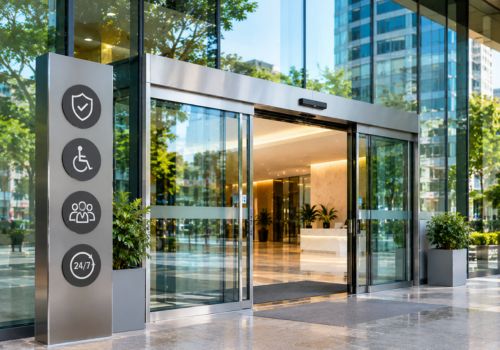
Automatic doors are becoming an important part of modern commercial buildings because they make entrances easier to use, support smooth pedestrian movement and help businesses manage daily operations. They also improve accessibility for people with limited mobility, support touchless entry, and can work with security and building management systems.
In busy places such as shopping malls, hospitals, hotels, offices and airports, the entrance is more than a way to enter or leave. It affects how people move, how they experience the building and how comfortably the indoor environment is maintained. This is why automatic doors for commercial buildings are now considered a practical entrance solution for many types of properties.
For commercial property owners, architects and facility managers, the decision is not only about appearance. The right commercial automatic doors should suit the building’s purpose, visitor numbers, security needs, available space and maintenance plan.
Traditional manual doors can work well in many locations. However, busy commercial entrances may need to handle a constant flow of employees, customers, visitors, patients and delivery staff.
A manual door requires users to push or pull it. This can become inconvenient when someone is carrying shopping bags, moving equipment, using a wheelchair or assisting a child. During busy periods, people may also need to wait for others to open and pass through the same entrance.
Automatic entrance doors reduce the need for manual handling. Depending on the system, sensors or other activation devices detect a user and open the door. The entrance then closes according to its programmed operation.
This can make everyday movement more convenient and help create a more organised entrance area. It is particularly useful in buildings where many different people use the same entrance throughout the day.
Automatic doors also allow property owners to plan entrances around wider building requirements, including accessibility, security, hygiene, climate control and professional appearance.
A commercial building should be easy to enter for different types of visitors. Automatic doors can support this by reducing the physical effort needed to open an entrance.
A heavy manual door can be difficult to operate for someone using a wheelchair, walking frame or mobility aid. An automatic entrance can provide a more convenient way to enter without needing to push or pull a door.
It can also help elderly visitors, parents with prams and people carrying luggage or heavy bags. The clear opening, approach area and door operation still need to be planned properly so that people can pass through safely.
Accessibility should not be treated as an extra feature added only when requested. It should be considered when planning the main entrances, internal access points and visitor routes.
The entrance is often the first physical interaction a customer has with a business. A door that opens smoothly can make arrival easier, especially during busy shopping hours or hotel check-in periods.
For retail stores, automatic doors can make it easier for customers carrying shopping bags to enter and leave. In office buildings, they help employees and visitors move through reception areas without repeatedly handling door handles.
These small improvements can contribute to a more welcoming experience and make the entrance easier to use.
High-footfall buildings need entrance systems that match the movement of people throughout the day. A narrow or poorly arranged entrance can create queues, congestion and uncomfortable crossing movements.
Automatic door systems can support a more organised flow when their opening width, speed, sensor coverage and configuration are suited to the location.
Consider how this works in different commercial environments:
The entrance must still be designed for the expected traffic. A system suitable for a small showroom may not be appropriate for a busy mall or transport building.
Touchless operation is another reason businesses consider automatic doors. Users do not need to hold a handle or push a door panel when the system is activated by suitable sensors.
This can be useful in locations where many people enter throughout the day or where users may have their hands occupied.
Touchless entry can reduce the need to handle shared door surfaces. However, an automatic door does not make an entire building contact-free or remove the need for regular cleaning.
For healthcare facilities, the entrance arrangement should also support patient movement, cleaning routines and the building’s operational requirements.
Also Read: Automatic Doors for Clinics in Dubai
Modern commercial properties often need to manage who can enter specific areas. Automatic doors can work alongside access-control equipment to support this process.
For example, an office may use a card reader near its entrance. An authorised employee presents a card, and the access-control system sends the appropriate signal to release the lock and operate the door.
Depending on the building’s security plan, automatic entrances may also be integrated with:
The door operator, locking hardware and access-control equipment must be compatible. The opening sequence should be planned so that the door does not try to move while a locking mechanism is still engaged.
Automatic doors can also be useful in controlled environments where different areas have different access permissions. For example, a data centre may need a public reception entrance and separate restricted-access zones.
Also Read: Automatic Doors for Data Centers in Dubai
It is important to understand that an automatic door alone does not provide complete building security. Its role should be considered as part of the wider access-control and security arrangement.
In Dubai, commercial buildings often depend on air conditioning to maintain comfortable indoor conditions. Frequent opening of exterior entrances can allow warm outdoor air to enter and cooled indoor air to escape.
A properly planned automatic entrance can help manage how long the doorway remains open. Sensors activate the door when people approach, and the system closes it after the required opening cycle.
This can help reduce unnecessary exposure between indoor and outdoor conditions. However, the actual effect depends on several factors, including:
Revolving doors may also be considered for some large commercial entrances where pedestrian flow and separation between indoor and outdoor conditions are important. Their suitability depends on the building layout, user needs and accessibility arrangements.
Automatic doors should not be treated as a guaranteed energy-saving solution. The building’s overall design and operation influence the result.
Not every commercial property needs the same entrance arrangement. The selected system should match the available space, visitor movement, building design and intended use.
Automatic sliding doors are commonly considered for malls, offices, hospitals, hotels and retail entrances. Their panels move sideways, so they do not need the same swing clearance as hinged doors.
They can be useful where people enter and leave frequently or where the entrance needs a wide, convenient passage.
Explore More: Automatic sliding door solutions for commercial entrances.
Telescopic systems use multiple sliding panels that move and stack together. They can be useful where a wider clear opening is required but the available side space is limited.
The entrance dimensions and panel arrangement need to be checked before selecting this option.
Explore More: Telescopic automatic doors.
Automatic swing doors can be suitable for entrances where a sliding arrangement is not practical or where the existing door layout uses hinged panels.
The swing path must be considered carefully. There should be enough space for the panel to open without creating an obstruction or risk to people nearby.
Revolving doors are often considered for larger hotels, office buildings and commercial properties with regular pedestrian movement. They allow people to enter and leave through rotating compartments.
Their design needs careful attention to user accessibility, safe movement and emergency arrangements. A revolving entrance should not be assumed to replace every accessible or emergency exit route.
The value of automatic doors for commercial buildings becomes clearer when the daily needs of different properties are considered.
| Commercial building | How automatic doors can help | Important consideration |
| Shopping malls | Support customer movement and convenient access with shopping bags and trolleys | High footfall, entrance width and sensor coverage |
| Offices | Make employee and visitor entry easier and support controlled access | Card readers, reception layout and security |
| Hospitals | Support movement for patients, wheelchairs and medical equipment | Accessibility, safety and emergency operation |
| Clinics | Provide convenient entry for patients and staff | Hygiene routines and available entrance space |
| Hotels | Improve guest arrival and movement with luggage | Lobby design, traffic flow and appearance |
| Airports | Support movement for passengers carrying bags and suitcases | Pedestrian volume and operational reliability |
| Showrooms | Create a convenient and professional customer entrance | Glass design and the building’s appearance |
| Restaurants | Help staff and customers move through suitable entrance areas | Door location, hygiene and service movement |
The same door system will not suit every building. Property owners should assess how each entrance is used rather than selecting a system only because it is common in another commercial property.
Automatic doors must operate safely for employees, customers and visitors. The safety arrangement should be suitable for the door type, installation location and people using the entrance.
Activation sensors detect approaching users and signal the door to open. Safety sensors monitor relevant areas around the moving panels and help prevent contact with people or objects.
The correct sensor type, position and coverage should be confirmed for the selected system. Sensor settings should also be checked during installation and commissioning.
The system should respond appropriately if a person or object is detected in a protected area. This is particularly important in entrances used by children, elderly visitors, wheelchair users and people carrying large items.
Commercial property owners should understand how the door will behave during a power interruption. Depending on the system and building requirements, the arrangement may include battery backup, UPS, generator supply, manual release or another approved emergency method.
The correct option depends on the entrance’s function and the wider building safety plan.
Also Read: Automatic Door Power Failure
Where the entrance forms part of a fire or life-safety strategy, the operation must be reviewed by the relevant project consultants and local authorities. Do not assume that a standard automatic opening arrangement is suitable for every emergency condition.
The entrance contributes to how people see a commercial property. A well-designed automatic glass entrance can give a building a clean and organised appearance while supporting convenient access.
This can be useful for:
The final appearance depends on the door panels, framing, hardware, surrounding finishes and installation quality. The system should fit the building’s architecture rather than look like an unrelated addition.
For commercial properties considering a wider range of entrance options, Deto explains the practical applications of automatic doors for commercial use in its existing guide.
Before choosing an automatic entrance, property owners and facility managers should review the actual needs of the building.
Building purpose: A hospital, mall, restaurant and office have different entrance requirements. Identify who will use the door and how frequently.
Daily footfall: Consider busy periods as well as average daily movement. The selected system should be suitable for the expected level of use.
Entrance dimensions: Check the available width, height, side space, ceiling space and floor condition.
Accessibility: Review clear opening space, approach routes and ease of use for people with mobility requirements.
Security: Decide whether the entrance needs card readers, keypads, intercoms or other access-control devices.
Electrical supply: Confirm that the required power and cable routes can be provided at the installation location.
Safety: Discuss sensor coverage, obstacle detection, emergency operation and any required connection with other building systems.
Budget: Consider the door system, glass and framing, operator, sensors, access-control equipment, installation and future servicing. The automatic door installation cost depends on the project and should be assessed after reviewing the site and requirements.
Maintenance: Check whether technicians can access the operator and control equipment. Ask about inspection intervals, spare parts and service arrangements.
Even a suitable automatic door system needs correct installation and ongoing maintenance. Poor alignment, dirty tracks, sensor issues or worn components can affect how the entrance operates.
Commercial properties should arrange servicing according to the manufacturer’s recommendations, usage level and site conditions. Regular checks may include:
The service needs of a busy shopping mall entrance may differ from those of a small office. Facility managers should keep maintenance records and report faults before they cause wider disruption.
Also Read: Average Lifespan of Automatic Sliding Doors in Dubai
For properties that need inspection, repair or ongoing support, Deto also provides information about its automatic door repair service in Dubai.
Manual doors remain suitable for many areas. Automatic systems offer different benefits where frequent movement, accessibility or controlled entry is important.
| Consideration | Traditional manual entrance | Automatic entrance system |
| Opening method | User pushes or pulls the door | Sensors or other controls activate the door |
| Accessibility | May require more physical effort | Can make entry easier for many users |
| Busy periods | Users operate the door individually | Can support continuous movement when correctly designed |
| Hands-free use | Usually not available | Possible with suitable touchless activation |
| Access control | May need separate locking arrangements | Can integrate with compatible access-control equipment |
| Safety | Depends on door design and user operation | Requires suitable sensors, controls and safety testing |
| Maintenance | Hinges, closers, locks and other hardware need attention | Operator, sensors, tracks and controls also need servicing |
Automatic doors are not automatically the best choice for every opening. The decision should depend on how the entrance is used, the building’s requirements and the ongoing responsibilities of the property owner.
Modern commercial buildings need entrances that support convenient access, safe movement and daily operations. Automatic doors for commercial buildings can help meet these needs by improving accessibility, supporting touchless entry, integrating with security systems and creating a more welcoming arrival experience.
The right solution depends on the property, its users and the entrance conditions. Deto Automatic Doors LLC provides automatic door solutions for commercial environments, including sliding and other entrance systems, along with installation and service support.
If you are planning a new commercial entrance or upgrading an existing property in Dubai, discuss your requirements with Deto Automatic Doors LLC. The team can help assess the entrance and identify a suitable solution for your building.
Automatic doors can make entrances easier to use, support pedestrian movement, improve accessibility and provide convenient hands-free entry. They can also integrate with access-control systems and help manage the time an entrance remains open.
The right type depends on the building and entrance. Sliding doors are common for busy entrances, telescopic doors can help where side space is limited, swing doors suit certain layouts, and revolving doors may be considered for some large commercial properties.
Yes, suitably designed automatic entrances can make access easier for wheelchair users and people using mobility aids. The clear opening, approach space, activation method and safety arrangements should be checked for the specific installation.
Touchless automatic doors use suitable sensors to detect approaching people and activate the opening cycle. The door then closes according to its settings and safety controls.
Automatic doors can work with card readers, keypads, biometric devices and intercom systems to support controlled entry. They should be integrated with the building’s wider security plan.
They can help reduce unnecessary exposure between indoor and outdoor conditions by controlling how long an entrance remains open. The actual effect depends on the door design, seals, traffic, weather and building layout.
Automatic doors may use activation sensors to detect approaching users and safety sensors to monitor protected areas around moving panels. The required devices and their positioning depend on the door system and site conditions.
The cost depends on the door type, entrance dimensions, glass and frame arrangement, operator, sensors, access-control requirements and site conditions. A site assessment is needed to prepare a suitable project estimate.
Maintenance frequency depends on usage, system type and manufacturer recommendations. Busy entrances may need closer attention than doors with limited daily use. Regular inspections help identify issues with sensors, tracks, motors and controls.
Start by reviewing the building’s purpose, pedestrian traffic, entrance dimensions, accessibility needs, security requirements, electrical supply and budget. Then discuss the site conditions and suitable system options with an experienced automatic door installer.