
November 08, 2026
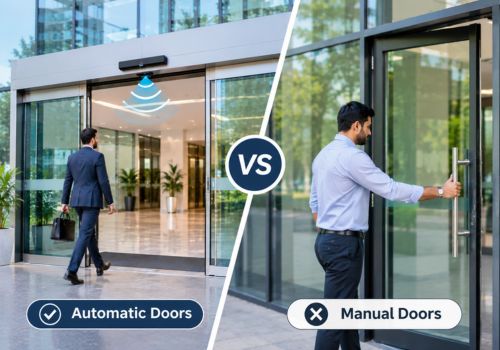
Automatic doors vs manual doors is an important decision when planning or upgrading a building entrance. Neither option is better for every situation. The right choice depends on the building’s purpose, daily pedestrian traffic, accessibility needs, security requirements, available budget and maintenance expectations.
Manual doors are often practical for smaller rooms, private spaces and entrances with limited foot traffic. Automatic doors are generally more suitable for busy commercial entrances where people need convenient, hands-free access throughout the day. They can also support wheelchair access, controlled entry and smoother movement when the system is correctly selected and installed.
For building owners, architects, contractors and facility managers, the decision should go beyond the initial purchase price. It is important to compare how each option performs during daily use, what maintenance it needs and whether it suits the people using the building.
The main difference is how the door opens and closes.
A manual door requires a person to push, pull or turn a handle to operate it. It may use hinges, a sliding track, a door closer or a locking mechanism. Its operation is usually straightforward and does not depend on an automatic motor or activation sensor.
An automatic door system uses an operator, control unit and suitable activation devices to open and close the door. Depending on the design, it may use motion sensors, presence sensors, push buttons or access-control signals.
Both options can be suitable for modern buildings. However, they serve different needs.
For example, a manual door may work perfectly well for a small office store room. The main entrance of a shopping mall, where customers enter with bags and trolleys throughout the day, may benefit more from an automatic system.
The following table highlights the main differences building owners should consider.
| Factor | Automatic doors | Manual doors | Where each may suit best |
| Initial installation cost | Usually higher due to operators, controls and sensors | Usually lower with fewer mechanical components | Manual for simple openings; automatic where added functions are needed |
| Daily convenience | Opens without manually pushing or pulling | Requires physical operation | Automatic for busy entrances |
| Accessibility | Can make entry easier for wheelchair users and people with mobility needs | May require more physical effort | Automatic where accessible movement is important |
| Hygiene | Supports hands-free entry | Users generally touch handles or panels | Automatic for high-use public entrances |
| Pedestrian flow | Can support frequent movement when correctly designed | Each user operates the door | Automatic for high-footfall areas |
| Safety | Needs correctly positioned sensors and tested controls | Depends on door design, closers and user operation | Both need suitable safety planning |
| Security | Can integrate with electronic access control | Can use mechanical locks and separate access devices | Depends on the building’s security plan |
| Energy efficiency | Controlled opening and closing may reduce unnecessary exposure | Depends on how users operate and close the door | Depends on entrance design and usage |
| Maintenance | Requires checks of operators, sensors and moving parts | Requires checks of hinges, handles, closers and locks | Manual for simpler maintenance needs |
| Repair requirements | May involve electrical, electronic and mechanical components | Often involves conventional hardware | Depends on the system and available service support |
The table shows that automatic doors vs manual doors is not simply a comparison between modern and old technology. It is a decision about which entrance arrangement suits the building and its users.
In many cases, manual doors have a lower initial installation cost. Their design may involve fewer components, especially when a standard hinged door is sufficient.
Automatic doors usually require additional equipment, such as:
The automatic door installation cost depends on the selected system, entrance dimensions, glass and frame materials, operator, sensors, access-control integration and site conditions.
For example, installing a basic manual door in a small office room is generally a simpler project than installing a large automatic glass entrance at a hotel or shopping mall.
However, the lowest initial cost may not always be the best long-term decision. If an entrance is used frequently, the convenience and operational requirements of an automatic system may justify considering the additional investment.
Property owners should compare quotations based on the complete scope of work, including installation, electrical provisions, safety equipment and future servicing.
One of the clearest differences between the two systems is how people move through the entrance.
With a manual door, each person must operate the door before passing through. This is usually manageable in low-traffic areas. At a busy entrance, however, repeated opening and closing can slow movement, especially when several people arrive together.
Automatic entrance doors open when activated by the selected control device. This can make entry more convenient for people carrying bags, luggage, documents or equipment.
Automatic doors do not automatically solve congestion. The opening width, sensor coverage, door speed and surrounding layout must be suitable for the expected pedestrian movement.
For a more detailed look at commercial applications, read Deto’s guide: Are Automatic Doors for Commercial Use a Smart Choice?
Accessibility is an important factor when choosing an entrance system.
A manual door can be difficult to operate for wheelchair users, elderly visitors, people using walking aids and anyone with limited hand or arm movement. Heavy panels and strong door closers may increase the effort needed to enter.
A suitably designed automatic door can reduce this physical effort. Users do not need to push or pull the panel when the system is activated by a sensor or another suitable control.
This can be useful in hospitals, clinics, hotels, offices and public buildings where visitors have different mobility needs.
However, an automatic door is not automatically accessible simply because it opens by itself. The building team should also consider:
The entrance should be assessed as part of the complete accessible route. Applicable Dubai and UAE requirements should be confirmed with qualified project consultants and relevant authorities.
Manual doors usually require users to touch a handle, push plate or door panel. In a busy building, these surfaces may be handled by many people during the day.
Touchless automatic doors can reduce the need for direct contact with shared entrance surfaces. Sensors detect approaching users and activate the opening cycle without requiring them to touch a handle.
This can be useful in:
However, automatic doors do not remove the need for regular cleaning or wider hygiene practices. Their value is that they provide a hands-free way to operate the entrance.
For healthcare properties, the door arrangement should also support patient movement and the facility’s cleaning procedures.
Also Read: Automatic Doors for Clinics in Dubai
Both automatic and manual doors can be safe when properly selected, installed and maintained. Their safety depends on the design, hardware, operating conditions and people using them.
Automatic systems may include:
The required devices and their positioning depend on the door type and installation conditions. They should be checked during commissioning and maintained according to the manufacturer’s instructions.
Manual doors also need appropriate safety arrangements. Hinges, closers, handles, locks and door panels should be in good condition. The door should not close too quickly or create unnecessary obstacles along the entrance route.
Glass doors need suitable glass and markings or other visibility measures where required by the applicable project design and regulations.
For both systems, building owners should confirm relevant safety requirements with qualified professionals. Where a door is part of a fire or emergency exit arrangement, its operation must be coordinated with the building’s approved life-safety plan.
Manual doors can provide effective basic security through mechanical locks, keys and other conventional hardware. They may be suitable for private rooms, storage spaces and areas that do not require electronic entry management.
Automatic doors can offer more integration options. They may work with card readers, keypads, intercoms, biometric devices and other compatible access-control equipment.
For example, an office building may allow employees to enter through a card reader while keeping certain internal areas restricted. The access-control system can send a signal to the door operator after an authorised entry request.
This makes automatic door access control useful in offices, business centres, hotels and facilities with controlled areas.
However, an automatic door does not provide complete security on its own. The lock, operator, access-control system and emergency arrangements must work together.
For a building with sensitive access areas, the project team should decide which entrances need electronic control and which can use conventional locking arrangements.
The energy performance of an entrance depends on more than whether it is automatic or manual.
In Dubai, air-conditioned commercial buildings need to manage the exchange of indoor and outdoor air. When an entrance remains open for longer than necessary, warm outdoor air may enter while cooled indoor air escapes.
An automatic door can be programmed to open and close according to its operating requirements. This may help reduce unnecessary exposure, particularly when the door is used frequently.
Manual doors can also help maintain indoor conditions when users close them properly after passing through. However, their performance depends on user behaviour and the door’s closing arrangement.
Actual automatic door energy efficiency depends on:
A revolving door may also be considered for certain large commercial entrances, depending on pedestrian flow and accessibility needs.
Neither system guarantees a fixed reduction in energy use. Building owners should assess the complete entrance design rather than expecting the door mechanism alone to determine energy performance.
Manual doors generally have fewer operating components. Their maintenance may involve checking hinges, handles, locks, closers, frames and door alignment.
Automatic doors have additional mechanical and electronic parts. Depending on the system, maintenance may include checking:
This does not mean automatic doors are unsuitable for buildings with heavy daily use. It means property owners should plan for appropriate servicing.
The actual lifespan of either system depends on the quality of the components, installation, usage conditions and maintenance. Busy entrances may need more frequent attention than doors used occasionally.
Also Read: Average Lifespan of Automatic Sliding Doors in Dubai
If an automatic entrance becomes slow, noisy or inconsistent, it should be inspected rather than left until it stops working. Deto provides information about its automatic door repair service in Dubai.
The most suitable option changes according to the building’s daily activities.
| Building type | Automatic doors | Manual doors | Practical recommendation |
| Hospital | Support movement for patients, wheelchairs and medical equipment | May suit private rooms and low-traffic internal areas | Automatic systems are often worth considering for main entrances |
| Office building | Convenient for reception areas and controlled employee entry | Suitable for meeting rooms, offices and storage spaces | Use according to footfall and access requirements |
| Retail store | Useful for customer entrances and frequent movement | May suit smaller stores with limited traffic | Consider automatic doors for busy customer-facing entrances |
| Residential building | Convenient for shared lobbies and controlled entry | Practical for individual rooms and many private entrances | Automatic for selected shared entrances; manual for most internal doors |
| Hotel | Helps guests enter with luggage and supports lobby movement | Suitable for guest rooms and many internal spaces | Automatic for main guest entrances where appropriate |
| Shopping mall | Supports frequent customer movement and wider entrance use | May suit service rooms and restricted back-of-house areas | Automatic systems are generally worth considering for main entrances |
For example, a hospital may need an automatic main entrance to support patient movement, while manual doors may remain suitable for offices and staff rooms. A small retail shop may not need automation at all if customer traffic is low and its entrance is easy to operate.
The decision should be made entrance by entrance, not necessarily for the entire building at once.
When an automatic system is suitable, the next step is to consider the entrance arrangement.
Manual alternatives are also available in hinged, sliding and other configurations. The important point is to compare the complete entrance arrangement, not just the opening mechanism.
Before making a decision, building owners and facility managers should answer a few practical questions.
For commercial properties in Dubai, Deto Automatic Doors LLC can help review entrance requirements and discuss suitable automatic door solutions. The final selection should be based on site conditions, manufacturer guidance and applicable local requirements.
The comparison of automatic doors vs manual doors does not have one answer for every building. Manual doors remain a sensible option for low-traffic spaces, private rooms and entrances where simple operation is enough. Automatic doors are often more suitable for busy commercial entrances where accessibility, hands-free entry, pedestrian movement or access-control integration matters.
The best approach is to assess each entrance according to its users, purpose, layout, budget and maintenance needs. If an automatic system is suitable, correct installation and regular servicing are important for dependable operation.
Deto Automatic Doors LLC offers automatic entrance solutions for commercial and other property requirements. If you are planning a new entrance or considering an upgrade in Dubai, contact Deto Automatic Doors LLC to discuss a suitable system for your building.
Manual doors require a person to push or pull them. Automatic doors use an operator and activation devices, such as sensors or push buttons, to open and close the entrance.
Automatic doors are often more suitable for busy commercial entrances where accessibility and frequent movement matter. Manual doors may be more practical for smaller spaces and low-traffic areas.
Generally, automatic doors have a higher initial installation cost because they require operators, sensors, controls and electrical connections. The actual cost depends on the system and site conditions.
A suitably designed automatic entrance can make access easier for wheelchair users because they do not need to push or pull the door. Opening width, approach space and sensor operation must also be suitable.
Neither system is automatically safer in every situation. Automatic doors need suitable sensors, obstacle detection and emergency arrangements, while manual doors need properly maintained hinges, closers, locks and panels.
Automatic doors generally need additional maintenance because they have motors, sensors, controls and other moving components. Manual doors usually have simpler hardware, although both types need regular inspection.
Automatic doors can help control how long an entrance remains open, which may reduce unnecessary exchange between indoor and outdoor air. Actual performance depends on the door design, usage and building conditions.
Touchless automatic doors reduce the need to handle shared door surfaces. However, they do not replace regular cleaning and other hygiene practices.
Sliding, telescopic, swing and revolving doors can all suit different commercial requirements. The choice depends on entrance dimensions, pedestrian movement, available space and building use.
Manual doors may be a better choice for low-traffic rooms, private offices, storage spaces and entrances where automation is not needed. They can offer a simpler and more economical solution for these locations.